
Heading to South Korea soon? Let’s get you ready with a few key phrases. Below, you’ll find 9 phrases that you will find useful. You will see the Hangul and then how to pronounce the phrase.
11 Everyday Essential Korean Phrases To Know For Your Trip
English is a reasonably widespread language in and around Seoul. In my experience, the majority of the locations you will visit during your journey will be able to help visitors and speak some English.

I feel that learning a few essential Korean phrases before your visit can go a long way. So I created this short guide of useful phrases for first-time travelers.
If you’re interested in saying more than “hello” during your trip, getting familiar with the Hangul alphabet can be a great help.
While the unfamiliar characters may initially seem intimidating, Hangul, the Korean alphabet, is straightforward and phonetic, so you can easily sound out words with some practice. You can learn the Hangul alphabet on your flight!
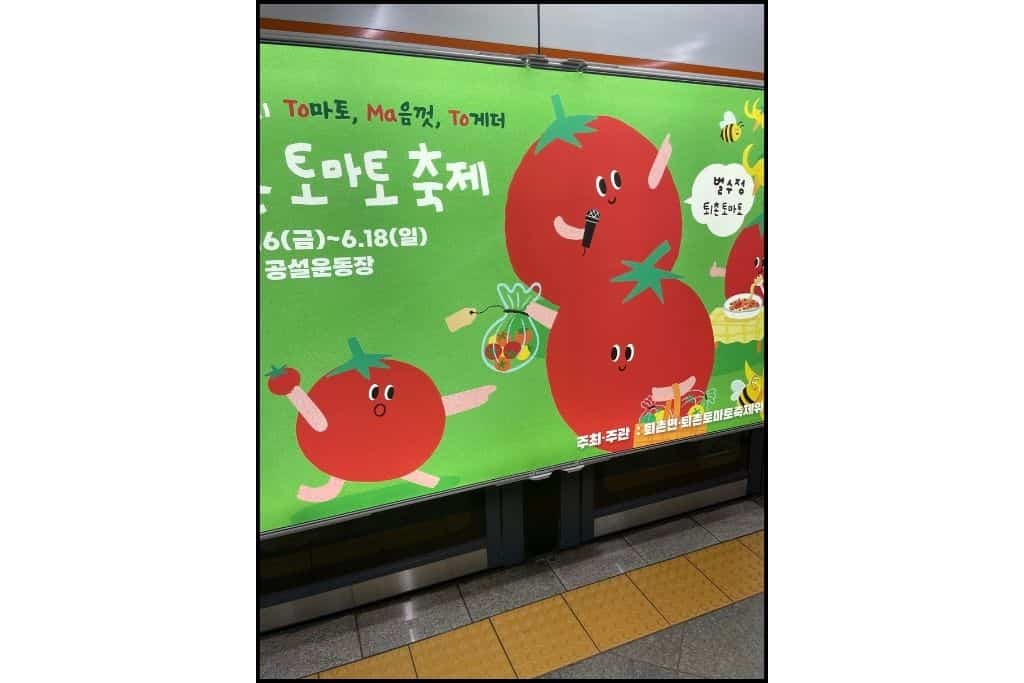
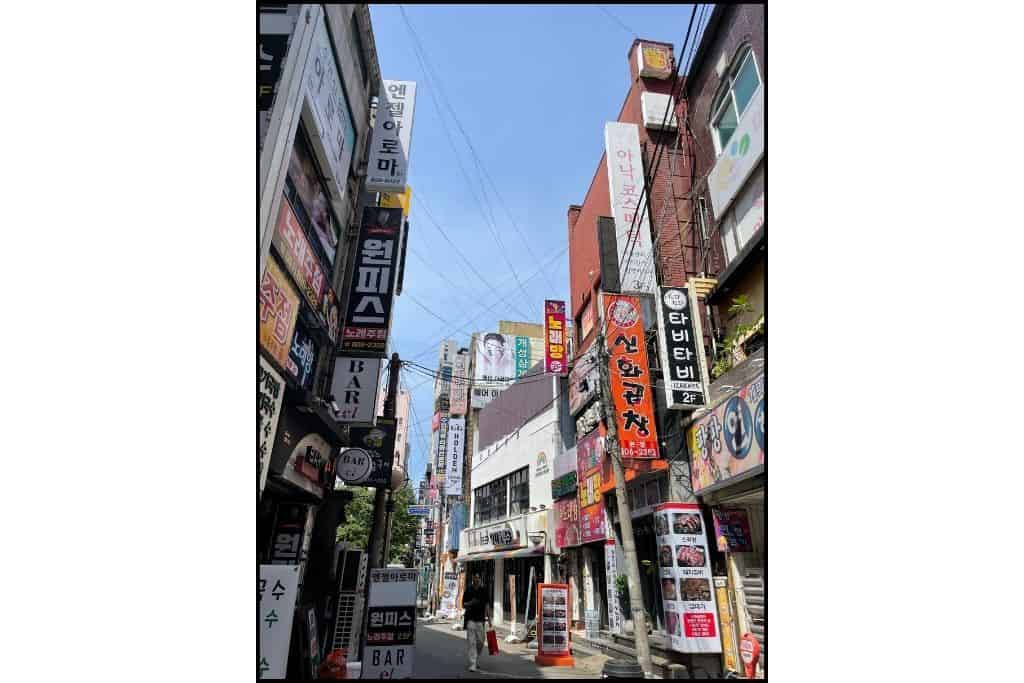
Learning the alphabet isn’t necessary to pick up a few helpful phrases for your trip. However, I will admit that it’s pretty cool to be able to read a subway or restaurant sign!
Note: Hangul, the Korean writing system, is phonetic, meaning the sounds of words are directly represented by the characters. However, one aspect that can be confusing is how certain consonants can appear interchangeable depending on the word or context, one example is “G” and “K”
Learning basic phrases for your trip to South Korea, like greetings, ordering food, or saying “sorry” if you accidentally bump into someone, can help make your experience smoother and help you connect with locals.
There’s no need to feel overwhelmed and memorize every phrase. These simple phrases are practical for travel and show courtesy without giving the impression that you’re fluent.
네 Ne
‘Ne’ means yes. You may hear something that sounds like ‘day’, which also means ‘yes’.
아니요 Ah-Ni-Yo
Ah-ni-yo means no. If you watch Kdramas, you might hear Ah-ni often. That is the informal. The -yo makes it formal. Please only say 아니 to your very good friends.
몰라요 Mol-La-Yo
This helpful phrase means I don’t know. This is useful for any situation where you don’t know what is going on or being said.
안녕하세요 Ahn-Nyeong-Ha-Se-Yo
This essential Korean phrase means hello. It can also sound like Ahn-Ya-Se-Yo. The ‘Nyeong” is super short and almost sounds dropped. Both are correct. However, most Korean people will expect to hear the entire pronunciation from you.
감사합니다 Kam-Sa-Ham-Ni-Da
This essential phrase means thank you. You might hear this one as Gam-sa-hab-nida. It really depends on the person and how they say it
Also, on the subway, say Kam-sa-ham-ni-da to get through the crowd. Saying “excuse me” is too formal for squeezing through the crowd.
저기요 Cho-Gi-Yo
This means ‘excuse me.’ It is used to get someone’s attention, for instance, at a restaurant or if you need assistance and want to ask someone a question.
미안해요 Mi-Ahn-He-Yo
This is the standard polite version of “I’m sorry.” It is used if you accidentally bump into someone or do something that you would normally say “I’m sorry” for.
Staying connected in Korea is a lot easier with a SIM card or eSim
👉 Grab your SKT Unlimited Local Data & Voice Calls Sim Airport Pick up HERE
OR
Grab your Korea eSIM with SKT Unlimited LTE data + Voice
Essential Korean Phrases for Restaurant and Shopping
잠시만요 Jam-Shi-Man-Yo
This helpful phrase means excuse me/just a moment – You might hear this when you enter a restaurant or cafe. They are letting you know they are aware you’re there.
주세요 Ju-Se-Yo
This essential phrase means please give, or want. You will use this to order food and drinks. 이거 주세요. I-geo ju-se-yo. Give me this, please. I-geo means this, something you are pointing at. If you want water: 물 주세요 Mul- ju-say-yo. Water, please
괜찮아요 Gwen-Chan-A-Yo
The helpful phrase means ‘Alright’. This popular phrase is both an answer and a question. “You ok/good?” “I’m all good/OK.”
얼마예요 Eol-Ma-Ye-Yo?
This question means, How much is it? This is good for shopping and perhaps eating street food. Usually they will answer in Korean and show how many fingers it is.
FAQ
Is there a good translation app I can use?
The translation app widely used in South Korea is Papago. You can read more about it HERE
How accurate are translation apps?
The translation apps are generally accurate and can be very useful for basic questions like asking for directions.
For more complex situations, translation apps often miss cultural nuances, and words can have multiple meanings depending on the context. For longer or more complex sentences, they may also produce inaccurate or confusing translations.
Will I be able to use English in most places in South Korea?
The answer is yes. You will most likely use English in most places you visit. The exception may be if you use taxis. I have used Papago to talk to a few taxi drivers with no issues. I do recommend downloading and getting familiar with the translation app Papago, but Google Translate works as well.
Some Final Thoughts
When traveling in South Korea, knowing a few essential phrases can make your trip much smoother and more enjoyable.
Simple greetings, polite words of gratitude, and ways to ask for assistance are particularly helpful in creating positive interactions with locals.

At the very least, practice saying hello and thank you. Even if your pronunciation isn’t perfect, the effort goes a long way when traveling in South Korea.
Using basic phrases not only bridges the language gap but also demonstrates respect for the culture, often creating more genuine and memorable interactions.
Locals appreciate when visitors try, and a little effort with essential phrases can lead to rewarding connections throughout your journey.